How to Turn a Successful Pilot Into a Business That Can Scale
A successful pilot is encouraging. It is not the same as a scalable business.
Pilot customers are often unusually motivated. They accept uncertainty, commit people, work around missing processes, and help integrate an offering that is not yet ready for normal use.
That is valuable evidence.
But Scaling-Up asks harder questions.
Will customers integrate the offering into their day-to-day business? Can the company deliver it repeatedly without exceptional support? And can the business win mainstream customers that expect the offering to fit into normal buying and operating processes?
A pilot proves that the offering can work under a specific set of conditions. Scaling requires evidence that the offering remains viable when customer adoption, delivery, support, and economics have to work at scale.
The Problem
Pilots often benefit from unusually favorable conditions.
Customers may provide strong sponsors, flexible access, responsive technical support, and people willing to solve problems as they appear. Internally, the initiative may receive senior attention, specialist support, fast decisions, and extra resources.
The problem starts when pilot success is interpreted as proof that the business is ready for rollout.
Early customers may be willing and able to absorb more uncertainty and integration effort. Mainstream customers usually expect clearer proof, easier implementation, lower disruption, and established support.
The same issue appears inside the company. A handful of pilot customers can be supported through expert attention and workarounds. A much larger customer base cannot.
This is one reason companies end up in what is often called pilot purgatory: the initiative has proved enough to continue, but not enough to justify Scaling-Up with confidence.
Is Your Growth Initiative a Hidden Bet? →
The Opportunity
A successful pilot creates the opportunity to ask a better question:
What had to be true for the pilot to work?
How much customer-side sponsorship was required? How much internal support? Which workarounds were used? How experienced was the customer with adopting new technology? What would happen if the next ten customers did not provide the same conditions?
This separates what has already been proved from what still needs to be learned before broader rollout.
The Solution
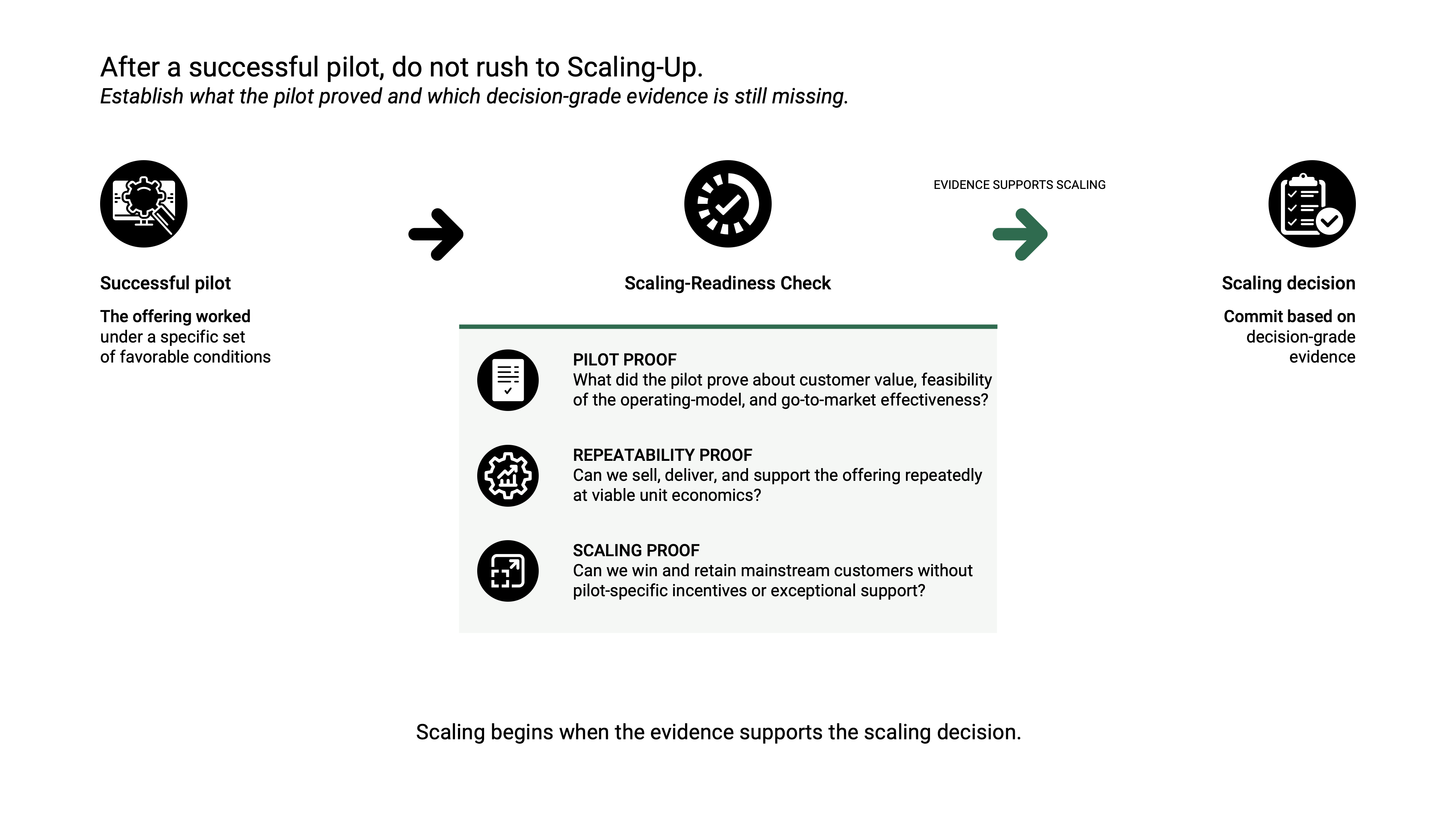
After a successful pilot, three kinds of proof matter.
Pilot Proof
What did the pilot actually prove?
A successful pilot showed that some customers saw enough value in the offering to commit time, people, access, and some degree of risk.
It may also have provided evidence on technical feasibility, customer value, usability, or workflow improvement.
But that proof was tied to the conditions under which the pilot was run. It did not yet show whether the offering would work with a broader customer base or under an operating model designed for scale.
Repeatability Proof
Can the company sell, deliver, and support the offering repeatedly?
Can Sales sell it consistently? Can Operations deliver it without heroic effort? Can Service support it? Do the economics still work once exceptional resources and workarounds are removed?
The question is whether the business can move from making individual pilots work to serving customers repeatedly through a viable operating model.
Scaling Proof
Can the business win customers beyond the pioneer and early-adopter group?
Mainstream customers usually expect lower adoption risk, stronger references, established support, and an easier path into their existing operations.
Scaling therefore requires evidence that mainstream customers will buy the offering, integrate it into their day-to-day business, and continue using it under commercial and operating conditions that work at scale.
Scaling readiness also depends on whether Business ownership is developing before Scaling-Up.
What Should Happen After a Successful Pilot?
The conversation changes from:
“Did the pilot work?”
to:
“What exactly did the pilot prove?”
A strong pilot may still leave important assumptions unresolved around day-to-day integration, implementation effort, customer support, operating costs, channel performance, or mainstream demand.
Those assumptions become the next learning agenda.
The next step is not automatically another pilot or a broader rollout. It is to resolve the uncertainty that matters most for the scaling decision and generate decision-grade evidence around it.
That may mean a controlled rollout, a commercial test, an operating-model test, a channel test, or evidence that customers will actually switch and integrate the offering into their normal operations.
Make It Work for You
Take one growth initiative with a successful pilot.
Ask:
What did the pilot actually prove?
Which conditions helped the pilot succeed?
Which of those conditions can we expect from the next ten customers?
What would have to change for the operating model to support ten, fifty, or five hundred customers?
What evidence do we have that mainstream customers will buy the offering and integrate it into their day-to-day business?
Which uncertainty needs to be resolved next before broader rollout?
Related Reading
Frequently Asked Questions
What does a successful pilot actually prove?
A successful pilot showed that some customers saw enough value in the offering to commit time, people, access, and some degree of risk. It may also have provided evidence on technical feasibility, customer value, usability, or workflow improvement. But that proof was tied to the conditions under which the pilot was run.
What evidence is still needed before we decide to roll out a successful pilot?
Identify what the pilot did not prove. Typical gaps concern customer switching and day-to-day adoption, the effort required to implement and support each customer, the scalability of the operating model, unit economics, channel performance, and whether mainstream customers will buy under normal commercial conditions.
Why do successful pilots still fail to scale?
Because pilots often benefit from conditions that cannot be sustained during rollout. Customers may provide strong sponsors and extra integration effort. Internally, the initiative may receive specialist support, fast decisions, and workarounds. Scaling requires the offering to remain viable when customer adoption, delivery, support, and economics have to work at scale.
What is the difference between pilot proof and scaling proof?
Pilot proof shows what worked with early customers under specific conditions. Repeatability proof shows that the company can sell, deliver, and support the offering repeatedly. Scaling proof shows that the offering can win mainstream customers and operate under commercial and operating conditions that work at scale.
What should we do after a successful pilot?
Do not move automatically into broader rollout. Identify the uncertainty that matters most for the scaling decision and resolve it with decision-grade evidence. That may mean a controlled rollout, a commercial test, an operating-model test, a channel test, or evidence that customers will actually switch and integrate the offering into normal operations.