Triple Win
Why Triple Win?
Beyond-Core growth creates different stakes for three parts of the organization.
People driving new growth may sit in a corporate innovation unit, venture-building team, Strategy, Business Development, or specialist roles around customer-centricity and design.
Three Things That Do Not Create Growth on Their Own
Evidence alone does not create growth
Evidence helps only if the assumptions that can actually derail the business are being tested.
Some important assumptions escape Lean Startup and risk analysis because they are already treated as facts.
Those Hidden Bets need to be exposed and tested with decision-grade evidence.
Alignment alone does not create growth
Leadership, Business Units, functions, and growth teams can support the same opportunity and still operate against different goals, incentives, constraints, and time horizons.
A Shared Beyond-Core Growth Agenda makes those trade-offs visible and creates the basis for adjusting the management system around the growth the company has chosen to pursue.
A successfully validated foundation for a new business alone does not create growth
Strong customer evidence, a credible business model, and a successful pilot still do not mean the company can own and scale the business.
Capabilities, systems, incentives, resources, and organizational fit may still need to develop.
Business ownership has to develop while the new business develops.
How Triple Win Works
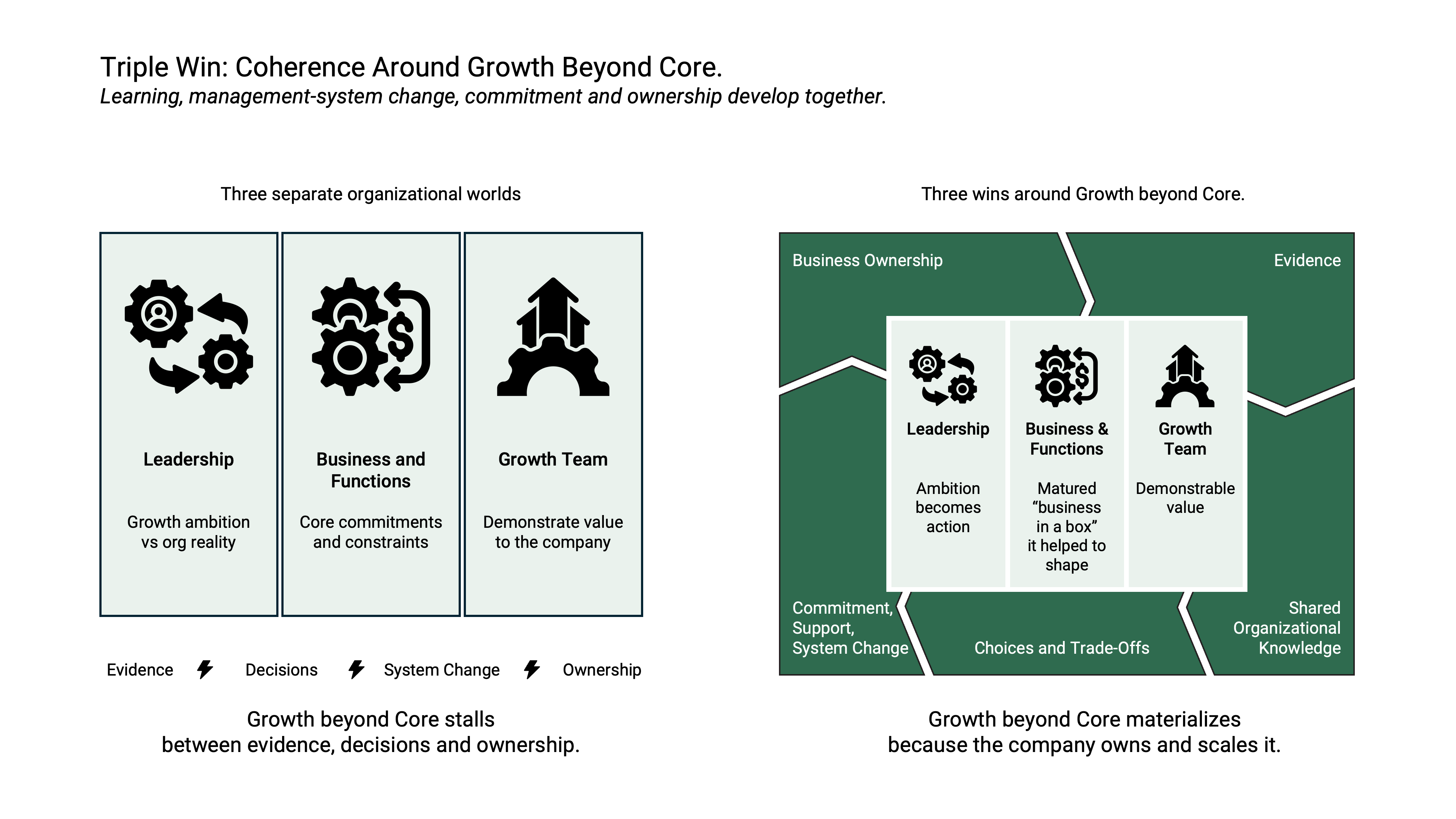
Triple Win keeps Leadership, the Business, and the people driving new growth connected.
Together they:
How to Turn Beyond-Core Growth Initiatives Into Material New Growth →
What Changes?
Leadership sees its growth ambition translated into action.
The Business gets a mature and validated growth business that it has helped shape.
People driving new growth — including innovation units and other specialist teams — can show that their work leads to decisions, support, and businesses the company can scale.
Make It Work for You
If the three parties are working in separate worlds, they may be involved in the same growth initiative without yet operating as a Triple Win.
Frequently Asked Questions
What is Triple Win in creating new growth businesses?
Triple Win is a Lean Scaleup operating principle that connects Leadership, the Business, and the people driving new growth.
Together they interpret evidence, make trade-offs explicit, adjust the management system where needed, and build the commitment and Business ownership required to create new growth businesses.
Why is alignment between innovation units and Business Units not enough?
Because agreement on the opportunity does not remove differences in goals, incentives, constraints, and time horizons.
Beyond-Core growth can require explicit trade-offs around priorities, resources, funding, governance, capabilities, and ownership. These trade-offs need to be made visible and managed.
When should the owner of a future growth business become involved?
Early. The future owner should help shape the opportunity while it is still developing rather than being asked to absorb a finished initiative later.
This allows organizational fit, capabilities, systems, incentives, and ownership to develop alongside the new business.
How does Triple Win turn evidence into commitment and support?
Evidence becomes useful when Leadership, the Business, and the people driving new growth interpret what it means together.
That shared understanding creates the basis for explicit choices about what to fund, change, support, build, or stop.
How is Triple Win different from innovation governance and portfolio management?
Innovation governance defines roles, decision rights, and decision forums. Portfolio management helps decide where to allocate attention and resources across initiatives.
Triple Win is broader. It connects the interests of Leadership, the Business, and the people driving new growth so that evidence, trade-offs, management-system changes, commitment, and ownership develop together.