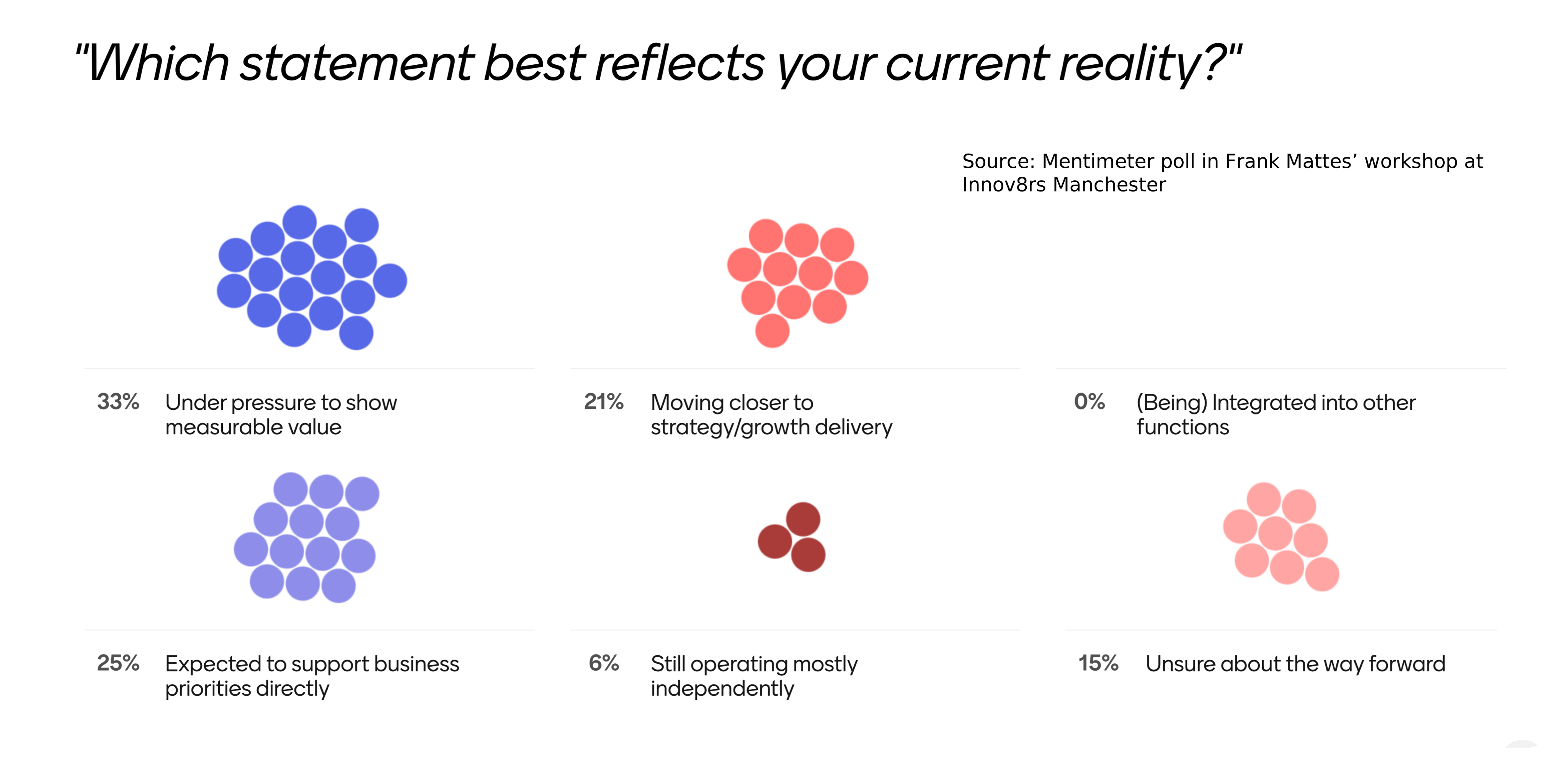
Corporate innovation is changing. At my recent Innov8rs Manchester workshop, I asked corporate innovators what best described their current reality.
The highest-ranked answers were telling: “Under pressure to demonstrate measurable value.” “Expected to support business priorities directly.” “Moving closer to strategy and growth delivery.”
The message is hard to miss. Innovation teams are being asked to move closer to the business, their budgets are shrinking and often, responsibility for Beyond-Core growth is moving into Business Units.
That does not mean companies need innovation less. It means they need it differently.
Moving growth into the BU does not remove the uncertainty
There is good logic behind giving Business Units greater ownership of growth. The BU owns the customers, the commercial capabilities, the operating model and ultimately the P&L. If a new business is ever going to scale, usually the existing business has to own it.
But there is a trap. Transferring ownership does not automatically make a Beyond-Core growth initiative execution-ready.
In my work with more than 50 Beyond-Core growth initiatives, roughly one third looked execution-ready but were actually growth bets.
Their success depended on untested assumptions about customers changing behavior and accepting the risks and costs involved, Sales teams prioritizing something unfamiliar over the Core business, Capabilities becoming available that did not yet exist, etc.
These are not normal execution questions.
They are assumptions about what needs to become true for the growth initiative to work.
The new role of Corporate Innovation
Corporate innovators have spent years learning how to work with uncertainty. They know how to identify assumptions, design experiments, generate evidence and learn before committing significant resources.
Those capabilities remain valuable even when the Business Unit owns the growth initiative. This may be where corporate innovation can create some of its most immediate strategic value: Help the business expose and de-risk hidden growth bets before plans, budgets and expectations harden.
That changes the relationship. Innovation is no longer asking the business to support its projects. The business has a growth initiative it wants to deliver.
Innovation helps determine where execution logic is sufficient and where the company still needs to collect decision-grade evidence to justify the next commitment.
From innovation ownership to growth infrastructure
The future role of corporate innovation may therefore be less about owning a separate pipeline of ideas. It may be about providing capabilities the existing business can draw on when growth moves beyond what its normal machinery was designed to handle.
That is a very different mandate. And perhaps a much more valuable one. The innovation team may disappear. The need to deal intelligently with uncertainty will not. Innovation in the future may be about making that capability part of how the company delivers growth.