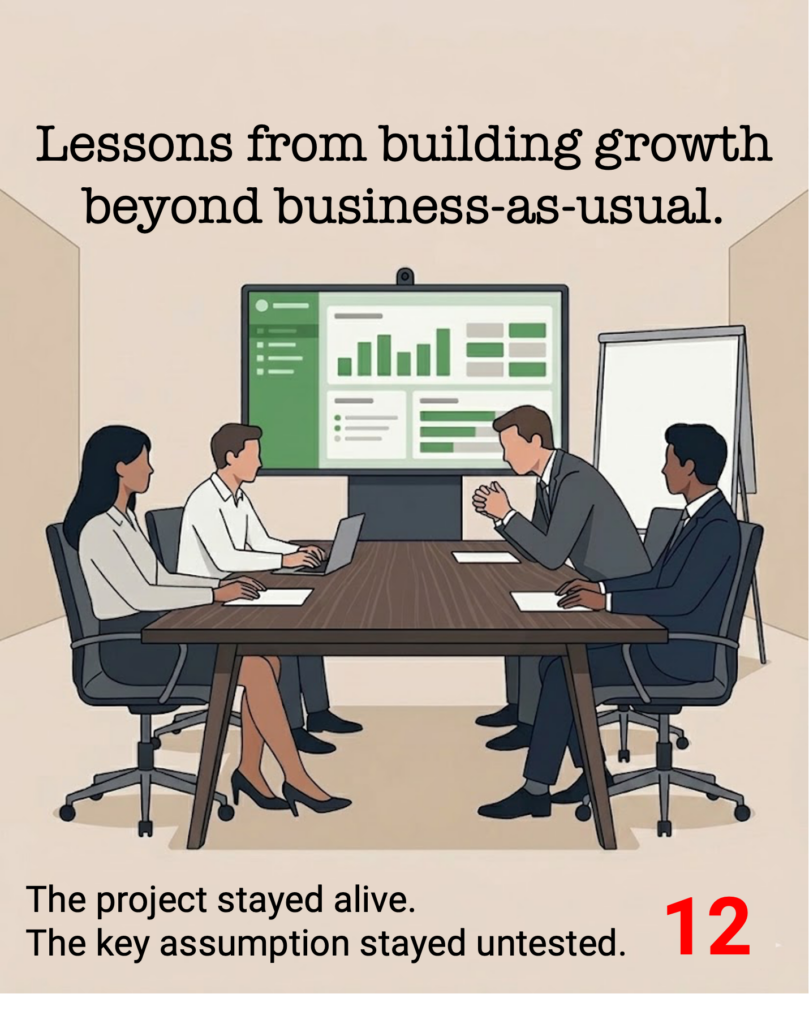
A MedTech company had invited me into a portfolio review. One diagnostics platform had been running for years. The clinical need was real. The technology worked. A few reference sites had achieved strong results. The initiative still appeared in leadership updates. It still had a committed team, internal supporters, and enough budget to continue.
The commercial review, however, showed slow adoption, uneven reimbursement, regional hesitation, long sales cycles, heavy support needs, and no clear path to repeatable growth.
That did not make the case for stopping obvious. In MedTech, patience is not automatically a sign of weak management.
Adoption cycles are long. Reimbursement takes time. Clinical stakeholders need evidence. Regional markets rarely move at the same speed.
The difficulty was deciding whether the platform was moving slowly because of the industry, or because the path to repeatable growth was not viable. Each group in the room saw part of that uncertainty.
Clinical teams saw a platform that could improve patient outcomes. Regional teams faced different reimbursement systems, buying processes, and levels of market readiness. Commercial teams could see interest, but not yet a scalable sales and support model. The platform team still saw the initiative as strategically important. They had invested in it and built support around it. More funding would give them more time to engineer the platform. That felt easier than questioning earlier decisions and forcing a decisive commercial test.
I wrote one sentence on the whiteboard: “For this initiative to scale, someone owns the trade-off decisions without sending every unresolved choice back to the C-suite.” The discussion then exposed the core problem. None of the perspectives on uncertainty was wrong. But together, they did not yet add up to a funding decision. The portfolio review team had not agreed which uncertainty had to be resolved next: repeatable customer adoption, reimbursement viability, or a scalable commercial model.
After this, the debate changed. Until then, the team had simply kept the platform moving, hoping that another funding round would somehow produce enough evidence to justify continuing.
The discussion now shifted to a much harder question: how to shape the next funding round so that it would resolve a decisive uncertainty and enable a confident decision to continue, pivot, or stop.
Questions senior managers often ask in this context:
How do you know whether a growth initiative deserves more funding?
A growth initiative deserves additional funding only if the next investment is expected to reduce a decisive uncertainty. The purpose of the funding is not simply to keep the initiative moving, but to generate the evidence needed to confidently continue, pivot, or stop.
What should a growth initiative prove before you invest more?
Every investment decision should be linked to a specific learning objective. Depending on the initiative, that may be repeatable customer adoption, reimbursement viability, a scalable commercial model, or another critical assumption. Funding should buy evidence, not just more time.
How do you decide what a growth initiative needs to prove next?
Start by identifying the uncertainty that matters most for the next investment decision. Rather than trying to reduce every risk at once, focus the next stage of work on generating evidence that resolves the single uncertainty most likely to determine whether the initiative should continue, pivot, or stop.
Why do companies keep funding growth initiatives without making a real decision?
This often happens when stakeholders agree that an initiative is strategically important but have not agreed on what it must prove next. Without a shared learning objective, each funding round extends the initiative without producing the evidence needed for a confident investment decision.