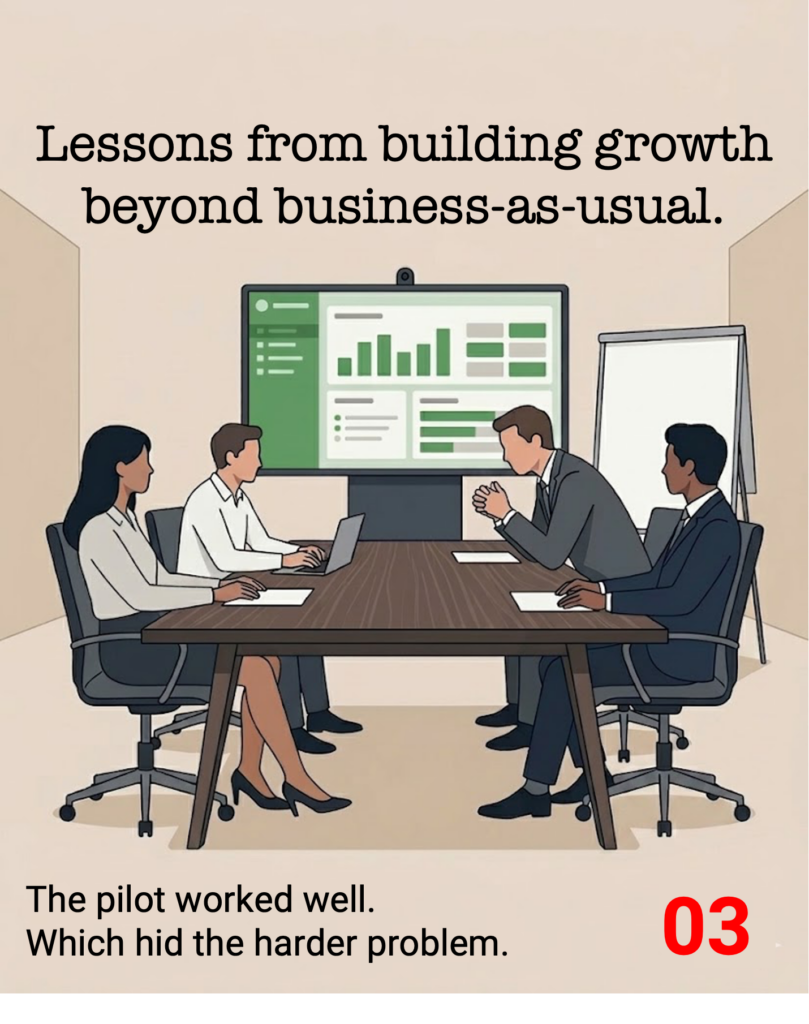
The growth team of a medical diagnostics company had completed a pilot with a large hospital group. The setting was almost perfect: a strong clinical sponsor, fast access to the hospital’s lab staff, committed IT support, and a regional commercial lead who wanted the project to succeed.
The pilot results looked strong. At the pilot site, lab turnaround time had improved. The lab team liked the workflow. The clinical sponsor wanted to continue.
The steering team treated the case as proof.
The next slide showed the rollout path: five more hospitals, then twenty, then additional regions. For a moment, the room felt like the hardest part was done.
Then the Head of Operations pointed to the pilot summary. “Which of these conditions will we get again? We can’t sustain this level of resource demand.”
The room stopped. The pilot had needed senior attention, a flexible IT team, extra application support, and a sponsor who removed obstacles before they reached the project team. None of this appeared in the broad rollout plan.
I asked the team to place the pilot conditions next to the rollout ambition. Then we wrote one sentence: “For this platform to scale, the next hospitals adopt it with less customer-side sponsorship and less internal support than the first sites.”
The room became less confident, but more thoughtful. Until then, the pilot had been treated as proof. Now the team saw something different. The pilot had proved feasibility under helpful conditions. It had not proved repeatability at scale. The rollout slide still showed twenty hospitals.
But now everyone saw the hidden assumption: the next hospitals would provide enough sponsorship, and each rollout would require less internal support.adoption at scale.
Questions senior managers often ask in this context:
Why do successful pilots fail when companies try to scale them?
Successful pilots often fail to scale because the pilot worked under special conditions. The first customer may have had a strong sponsor, flexible IT support, motivated users, and extra attention from the vendor.
Scaling becomes difficult when the next customers cannot provide the same level of support.
How do we know whether a pilot is truly scalable?
A pilot is truly scalable when later customers can adopt the solution with less support, not more.
Senior managers should check whether implementation time, customer-side effort, internal support, and sponsor involvement decrease as the rollout expands.
What should we check before rolling out a pilot to more customers or sites?
Before approving rollout, check what made the pilot succeed. Was success driven by the product and repeatable adoption model — or by exceptional people, extra resources, and a highly supportive first customer?
If the rollout plan ignores those conditions, the business case may be too optimistic.