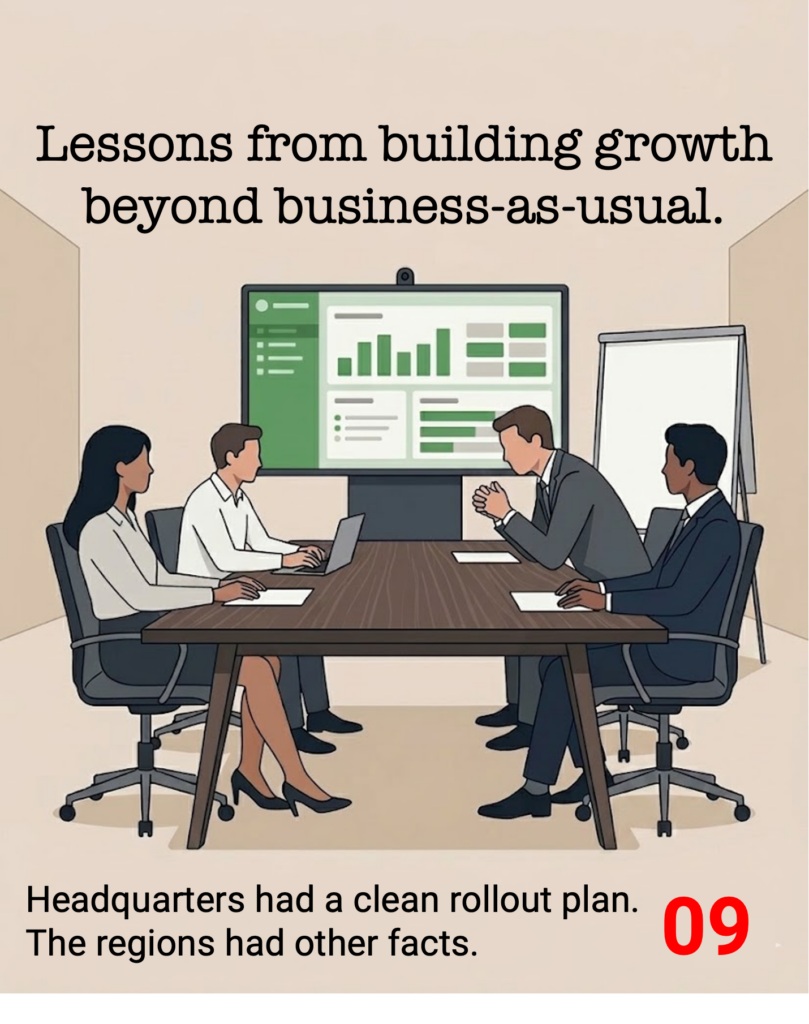
A company from the building systems industry had invited me into a progress meeting for a new façade system. Headquarters had built a strong concept: better energy performance, cleaner installation, and a simpler package for architects and contractors.
The central team had prepared the rollout map carefully. Germany came first, with two customers already in place. Austria, France, the Nordics, and selected Eastern European markets followed. The plan was not naïve. The team had thought through sequencing, training waves, launch material, and country targets.
Then the country leads started speaking. Their comments did not sound like resistance. They sounded like facts from the field. One country had different fire-safety expectations. Another had contractors loyal to a competing installation method. A third relied on distributors who preferred individual components over full systems. In another country, public tenders made the premium hard to defend.
None of these comments made the concept weak. But they made the rollout logic less straightforward. What had looked like a rollout sequence started to look more like an adoption-readiness map.
The rollout map stayed on the screen. I asked the team to mark each country with the local condition most likely to slow adoption. Then I wrote one sentence on the board: “For this system to scale internationally, the core offer must fit local building norms, channels, and buying habits.”
Until then, the team had discussed what was needed to roll out the offer: training waves, launch material, country targets. All of that mattered. But the country discussion surfaced a different question.
The issue was not whether the system could be launched in each country. It was whether each country was ready to adopt it. The team had validated a strong central concept. They had not yet validated whether that concept could travel across countries without losing its logic.
After this, the rollout discussion changed. The question was no longer which country came next. The question was how to shape rollout waves around the countries with the strongest adoption conditions, then use early references to open up the next doors.
Questions senior managers often ask in this context:
Why did our innovation succeed in one country but struggle in others?
Success in one country does not prove that the same offering will succeed elsewhere. Different regulations, channel structures, buying habits, competitive dynamics, and customer expectations can undermine the assumptions that made the first market successful.
How do we know whether our offering will work in other countries?
Before expanding internationally, validate more than the product. Check whether local regulations, sales channels, buying behavior, implementation practices, and commercial conditions support the same value proposition and business model.
What should we check before investing in the next wave of international expansion?
Before expanding into additional countries, identify the local conditions most likely to slow adoption. Prioritize markets where the offering already fits local needs and market conditions, then use those successes to build evidence and momentum for more challenging markets.