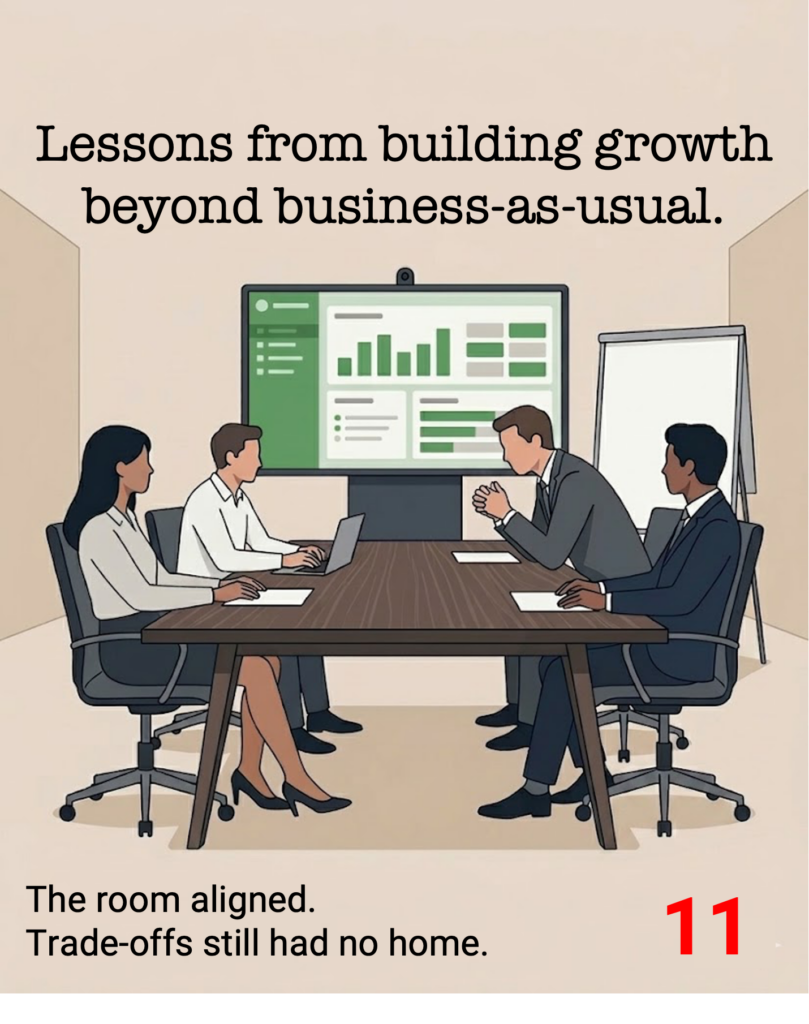
A specialty chemicals company had invited me into an alignment meeting for a recyclable packaging initiative. R&D, sustainability, sales, marketing, and two regional business leaders were in the room.
The first hour went well. R&D confirmed technical readiness. Sustainability saw strong external relevance. Sales liked the customer story. Marketing had campaign ideas. The regional leaders agreed the topic belonged on the growth agenda. It felt like alignment.
Then the project lead asked who would decide which customer applications to prioritize first. The room paused. A few people looked back at the slide. Others exchanged brief glances.
Until that moment, the initiative had sounded aligned. Now the choices underneath that alignment were becoming visible.
R&D wanted the application with the best technical fit. Sales wanted the customers already asking for alternatives. Sustainability wanted proof points that would be visible externally. Regions wanted relevance for their local accounts. Marketing wanted a story simple enough to build a campaign around.
Each view made sense. But if every view stayed equally important, there was no strategy. Only agreement.
I wrote one sentence on the whiteboard: “For this initiative to scale, someone owns the trade-off decisions without sending every unresolved choice back to the C-suite.” The unresolved choices were now clear: first application, first region, first customers, first proof points, and the priorities that would have to wait.
Everyone supported the initiative. Everyone saw the logic. Everyone wanted progress. But alignment was easy while no one had to give up a priority. The team had validated internal agreement. They had not yet validated decision ownership. Without decision ownership, the initiative did not yet have focus.
Questions senior managers often ask in this context:
Why do growth initiatives stall even when everyone supports them?
Growth initiatives stall when support is broad but decision rights are unclear. Different functions may back the same ambition while favoring different customers, applications, regions, or success measures. Progress requires someone to make and own the trade-offs.
Why does cross-functional alignment still fail to produce decisions?
Cross-functional alignment does not produce decisions when nobody has the authority to choose between competing priorities. If every difficult trade-off returns to the C-suite, the initiative may be aligned in principle but unable to move in practice.
How should we assign decision rights in a cross-functional growth initiative?
Assign a clearly named decision owner with the authority to prioritize customers, applications, regions, and proof points. That person should resolve most trade-offs without escalating every choice to senior leadership.