How to Build Ownership for a New Growth Business Before Scaling
A new growth business has to find its place inside an organization that is already running at full speed.
Business Units operate within tight systems of KPIs, budgets, processes, governance, and scarce management attention. Sales, Operations, Finance, IT, and HR face the same reality.
The new business may need different pricing, channels, systems, capabilities, decision rules, or resources.
The Problem
The tension starts when the new business asks the existing organization to operate differently.
Sales may need new targets. Operations may need different delivery routines. Finance may need another funding logic. IT may need to adapt systems. The Business Unit may need to free up people and management attention for a business that is still small.
At the same time, the new business may also need to adapt its pricing, service model, channels, or operating model.
If this fit remains unresolved, tensions rise. The growth team experiences the Business Unit as rigid. The Business Unit experiences the new business as a stream of special requests.
The Opportunity
The opportunity is to establish organizational fit while the new business is still being developed.
The growth team and the future owner identify where the existing organization already gives the new business an “unfair advantage” through customers, channels, capabilities, systems, brand, or infrastructure, and where the fit breaks down.
Then both sides adjust.
The new business adapts where it can fit the company without weakening the business model. The existing business adjusts where its current setup would prevent the new business from succeeding.
Run Effective BU–Innovation Strategy Dialogs →
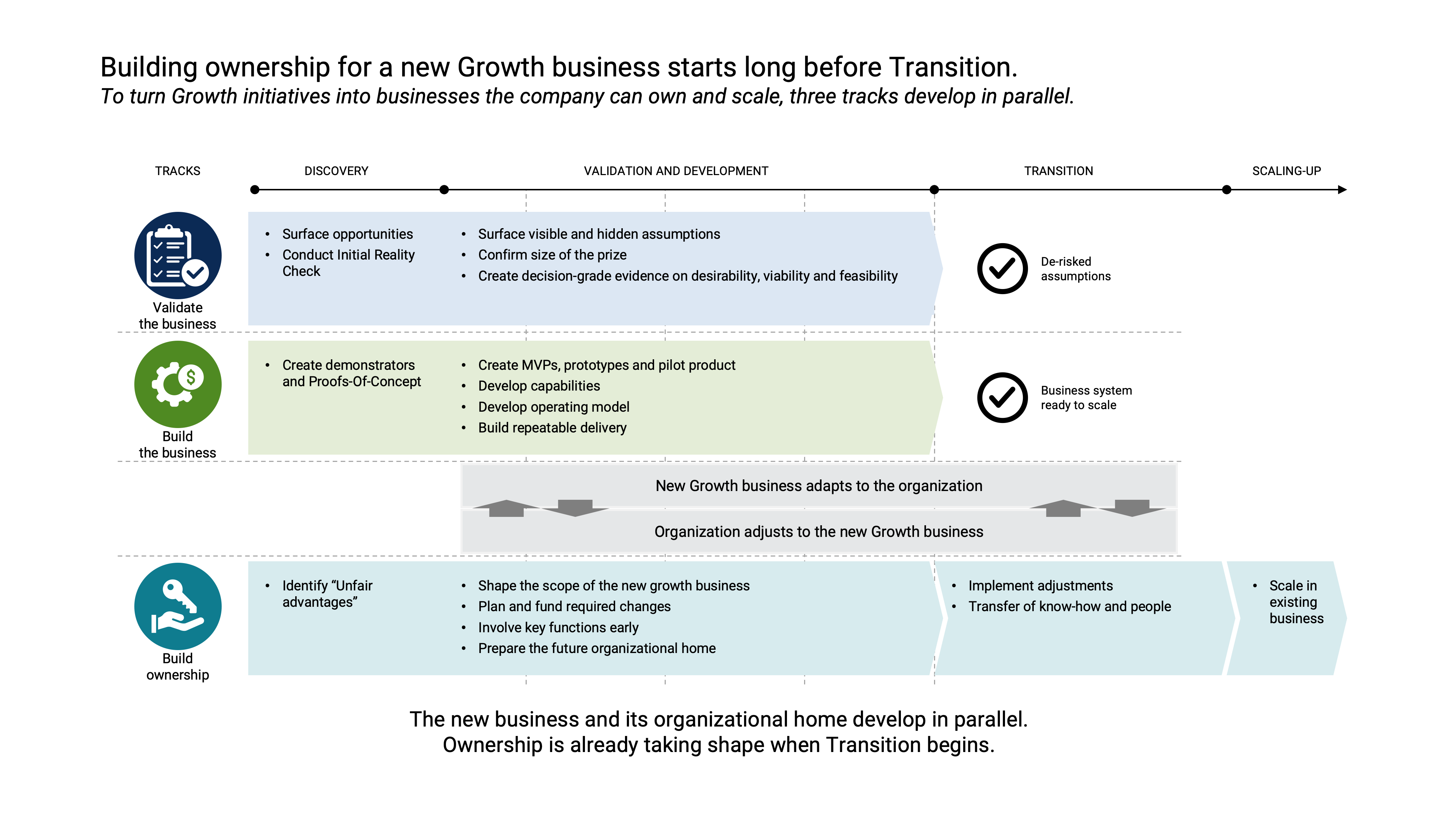
The Solution
Building a new growth business requires three tracks in parallel:
The third track starts early.
Ownership questions quickly become concrete: Which capabilities can already be used? Which KPIs or incentives need to change? Does pricing fit existing systems? Who funds missing capabilities? Where are exceptions needed?
What Changes When Ownership Starts Early?
Ownership becomes visible in how the business is run.
The new business may adjust its pricing, channels, service model, or operating routines. The existing Business may adjust KPIs, budgets, systems, incentives, decision rights, or resources.
These changes make ownership operational.
Make It Work for You
Take one new growth business that may eventually move into an existing Business Unit.
Ask:
Frequently Asked Questions
Why is our Business Unit hesitant to take over a new business even though the pilot looks successful?
Because a successful pilot does not show what ownership will require in practice. The new business may need different pricing, Sales incentives, service workflows, IT systems, resources, KPIs, or decision rights. Hesitation is often a rational response to unresolved questions about fit, resources, and operating reality.
When should the future business owner get involved in a new growth business?
Early enough to understand the size of the prize and what it takes to win. The future owner needs time to understand the business potential, the capabilities and changes success will require, and what that means for the existing Business before Scaling-Up begins.
How do we prepare a Business Unit to own a new business without disrupting the Core?
Treat ownership as a parallel workstream. The new business identifies where it can work within the existing setup and where it needs something different. The Business Unit identifies which KPIs, budgets, systems, incentives, processes, or resources need to change.
What needs to change inside the company before a new business can scale?
Often several things. Pricing may need to change. Sales targets or incentives may need adjustment. Service workflows, IT systems, decision rights, funding logic, or dedicated resources may need to be put in place. These changes make ownership operational rather than theoretical.
How do we avoid a late handover where the growth team is ready but the Business is not?
Build ownership while the new business is still developing. Involve the future owner early enough to understand the size of the prize, what it takes to win, and what the Business may need to change. That gives both sides time to shape the business and its organizational home before Transition.